
- Home
- Meetings & Events
- Events
- Second Meeting of the CSCAP Study Group on Biosecurity and Health Security
Meetings & Events
Second Meeting of the CSCAP Study Group on Biosecurity and Health Security
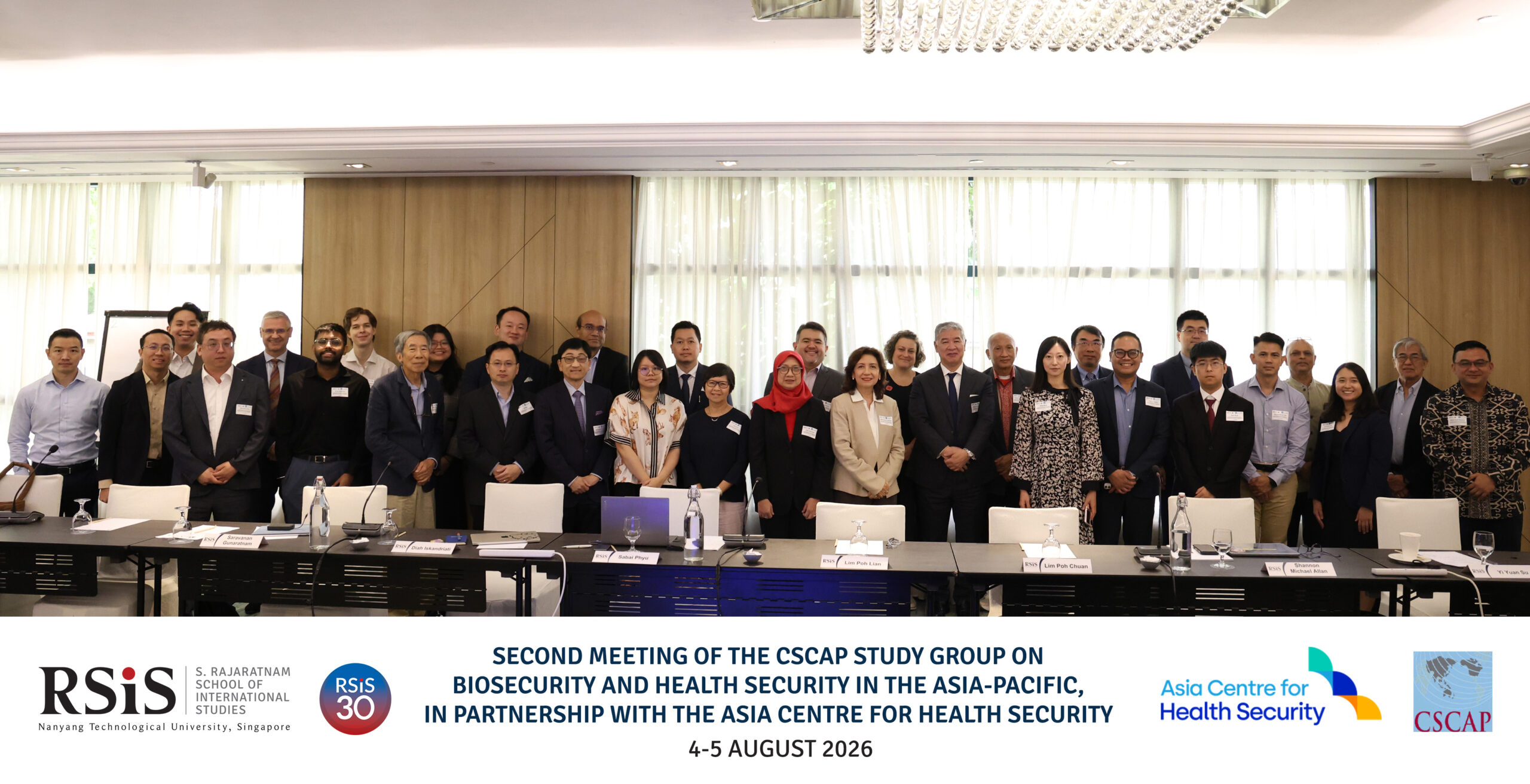
Participants of the Second Meeting of the CSCAP Study Group on Biosecurity and Health Security, held on 4–5 August 2026 in Singapore.
On 4–5 August 2026, the Council for Security Cooperation in the Asia Pacific (CSCAP) Singapore, represented by the Centre for Non-Traditional Security Studies (NTS) at the S. Rajaratnam School of International Studies (RSIS), Nanyang Technological University (NTU), hosted the Second Meeting of the CSCAP Study Group on Biosecurity and Health Security in the Asia-Pacific.
The meeting was organised in partnership with the Asia Centre for Health Security, and was co-chaired by Professor Mely Caballero-Anthony, Lead, Biosecurity and International Security, ACHS/CSCAP Singapore, and Head, NTS, RSIS; Ms Angela Woodward of CSCAP New Zealand; and Professor Akiyama Nobumasa of CSCAP Japan.
Building on the Study Group’s first meeting, participants discussed emerging developments in biotechnology and artificial intelligence, their implications for biosecurity and health security, and the role of existing mechanisms, including the Biological Weapons Convention’s Confidence-Building Measures, in supporting regional cooperation. The participants also exchanged perspectives on scientific collaboration, information-sharing, and practical approaches to strengthening preparedness across the Asia-Pacific region.
The meeting also featured a tabletop exercise which explored regional responses to synthetic biological innovation across countries with differing levels of resources and capacity. This exercise identified several gaps, including uneven access to information, differences in national preparedness and capacity, and the need for clearer channels of regional coordination and communication. It also highlighted the importance of transparency, preparedness, coordination, and confidence-building, and encouraged constructive discussion on strengthening regional approaches to evolving biological technology risks.