
- Home
- Education & training
- Courses & workshops
- Biosecurity Simulation Exercise (BSX 2026)
Courses & workshops
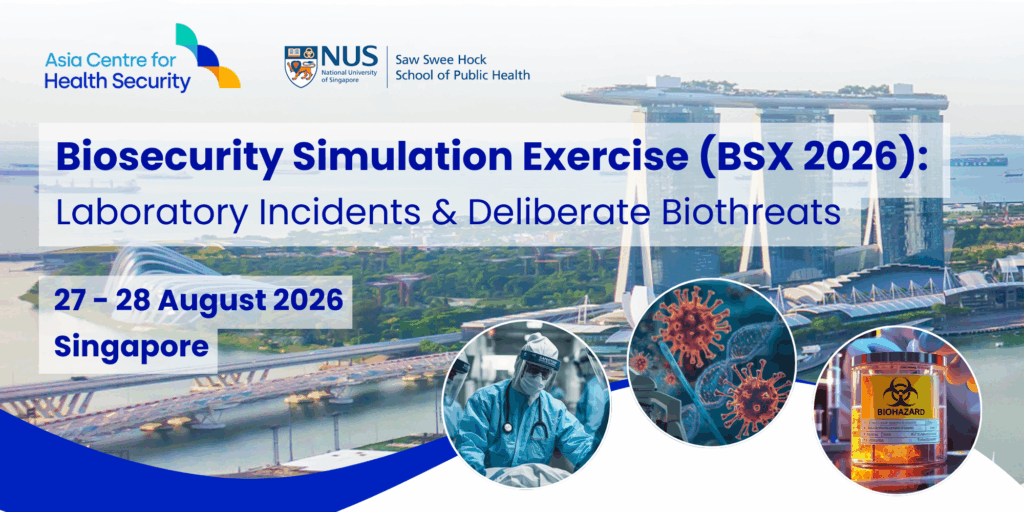
Biosecurity Simulation Exercise (BSX 2026)
Course Overview
This table-top simulation exercise aims to enhance inter-sectoral and inter-disciplinary preparedness for laboratory biosafety and biosecurity (LBB) and deliberate biothreat events (DBE). Through lectures, discussions, and structured, scenario-driven exercises, participants will explore decision-making to detect, risk-assess, and manage high-consequence biological incidents under conditions of incomplete information and unfolding events. Participants will collaborate in teams, building on expert perspectives to address issues in surveillance, diagnostics, public health response, security assessment, and risk communication.
Biosecurity Simulation Exercise (BSX 2026)
Date: 27 – 28 August 2026
Venue: Grand Copthorne Waterfront Hotel, Singapore
The full programme will be released soon. Please stay tuned for updates.
Objectives:
Strengthen surveillance, preparedness, and response for potential incidents involving laboratory biosafety and biosecurity and deliberate biothreat events.
Enhance inter-sectoral and inter-disciplinary coordination and decision-making through team-based problem-solving.
Review legal, policy, and security aspects for public health responses to such incidents.
Benefits of attending:
Practise high-stakes decision-making in a safe environment using scenarios.
Gain insights from the multidisciplinary approach required to address such incidents.
- Connect with international experts and regional counterparts.
Who should attend?
Professionals in public health, clinical medicine, laboratory sciences, policy, defence, and law enforcement whose work involves either laboratory biosafety and biosecurity, or preparedness and response for bioterrorism.
Proficiency in English (written and spoken) is required to actively participate and benefit from the meeting.
Course Fees
Standard registration: SGD 750
Low- and Middle-Income Countries (LMIC)* registration: SGD 250
Nett price is inclusive of 9% Goods and Services Tax
Standard registration: SGD 750
Low- and Middle-Income Countries (LMIC)* registration: SGD 250
*To be eligible for the LMIC course fee, you must be working or studying in a country classified as LMIC as listed by the Organisation for Economic Co-operation and Development (OECD).
**Due to a payment system transition from 1 August 2026 (Singapore time), any payments made on or after this date will be subject to varying bank fees depending on your selected payment method.
- an undergraduate or master’s degree-seeking student; and/or
- based (working or studying at an institution) in a country that is listed as a lower-income or middle-income country by the Organisation for Economic Co-operation and Development (OECD).
CPD Points
Participants who wish to obtain CPD Points are reminded that they must comply strictly with the Attendance Policy set out in the CPD Guidelines. For this activity, this includes logging in at the start of the webinar and logging out at the conclusion of the webinar on each day of the activity, and not being away from any part of the webinar for more than 15 minutes on each day of the activity. Participants may obtain Public CPD Points for each day of the event on which they comply strictly with the Attendance Policy. Participants who do not comply with the Attendance Policy on any particular day of the activity will not be able to obtain CPD Points for that day of the activity. Please refer to Singapore Institute of Legal Education CPD Centre for more information.
Session Details
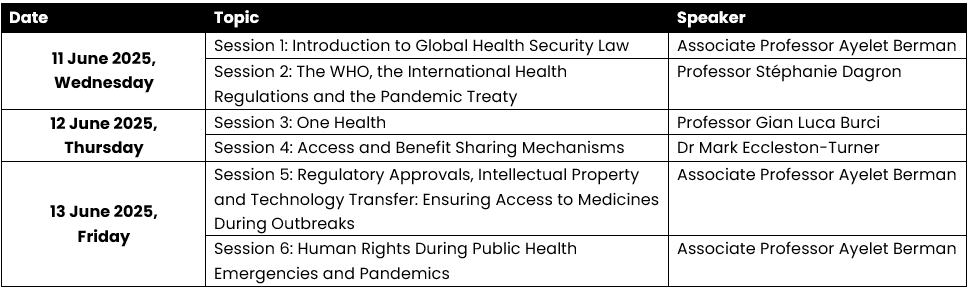
Sessions will be moderated by Associate Professor Ayelet Berman.
This session explored the definition, scope, and key functions of global health security law. It provided an overview of major actors, including the World Health Organization (WHO), and the legal instruments shaping this field, from binding treaties to soft law mechanisms. Core themes include public health emergencies and pandemics. The session also examined significant developments, such as International Health Regulations (IHR) and Pandemic Treaty reforms, along with critical challenges.
The prevention and control of the spread of infectious diseases has been a central field for cooperation between States since the 19th century. The IHR (2005), adopted under the auspices of the WHO, was analysed, as well as the way it has been implemented so far. The main amendments to the IHR adopted in June 2024 were discussed, as were the efforts to translate the lessons from the COVID-19 pandemic into a legally binding instrument, and the essential role of the WHO in the global governance of health security.
Health has become a central issue in the current discourse on global health law and governance. The increasing frequency of zoonotic diseases such as COVID-19 points to the need to reconcile human and animal health as well as environmental protection. This session discussed the current state of international law in promoting or hindering a holistic approach that overcomes a purely anthropocentric perspective. It also reviewed the inclusion of upstream prevention and the One Health approach in the WHO Pandemic Treaty and in the work of the so-called “Quadripartite” (WHO, FAO, WOAH, and UNEP).
This session explored the historical origins of Access and Benefit Sharing (ABS) as a transactional, market-based solution to problems of bio-conservation in international environmental law, and how ABS came to be adopted into mainstream public health. Through the case studies of 2005 – H1N1, Ebola in West Africa, MERS, Zika, and COVID-19, we explored to what extent ABS can effectively function in the public health space. We concluded by considering how (and why) ABS is being proposed in the ongoing negotiations of the Pandemic Treaty at the WHO.
This session explored the legal and regulatory frameworks that shape fast and equitable access to medicines and vaccines during infectious disease outbreaks. Key topics included the role of regulatory approvals and Emergency Use Authorisations, the impact of intellectual property rights under the Trade-Related Aspects of Intellectual Property Rights Agreement, and the use of technology transfer and voluntary licensing initiatives. Additionally, the session examined recent efforts to address these issues within the context of the proposed Pandemic Treaty currently under negotiation by the WHO.
This session explored the balance of human rights and governmental measures during public health emergencies such as pandemics. It examined how international human rights law applies in crises, balancing public health measures with fundamental freedoms. Key topics included the right to health, limitations on movement (quarantines and lockdowns), vaccine mandates, and the protection of vulnerable populations. It also discussed government responses to COVID-19.
Keynote Speakers

Professor Stuart Blacksell
Professor of Tropical Microbiology
Mahidol-Oxford Tropical Medicine Research Unit (MORU)
Thailand

Professor Raina MacIntyre
Head, Biosecurity Program, Kirby Institute
University of New South Wales
Australia
Meeting Moderator

Adjunct Professor Poh Lian Lim
Lead, Biorisk Management
Asia Centre for Health Security;
Group Director, Communicable Diseases Programmes
Communicable Diseases Agency (CDA)
Singapore
Dr Mark Eccleston-Turner
Senior Lecturer in Global Health Law, King's College London
Registration of Interest
Registration closes on Thursday, 30 April 2026, 5:00pm Singapore time (GMT+8).
Please view the Terms & Conditions before registering your interest for this meeting.
Please view the Terms & Conditions before registering your interest for this meeting.